
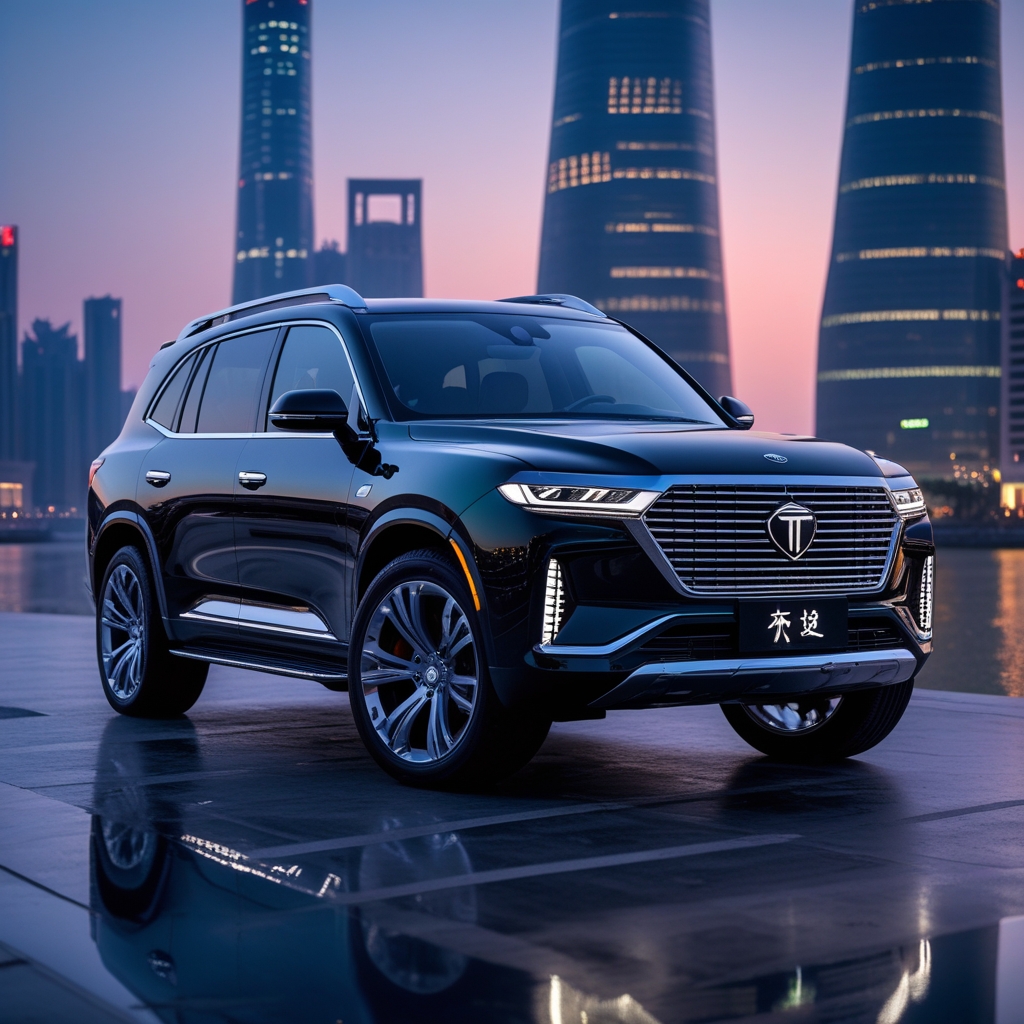
In a bold move against the global tide, Great Wall Motors’ (GWM) TANK brand has announced the development of China’s first fully in-house developed V8 engine. This milestone, showcased at CES 2026 in Las Vegas, is more than a technical achievement; it’s a strategic statement that redefines the ambitions of Chinese brands in the global luxury automotive market.
The Technical Feat: Inside the GWM V8 Engine
After over three years (and reportedly more than a decade) of development, GWM presents an engine designed to rival the best from established global powerhouses.
| Technical Specification | Details |
|---|---|
| Displacement & Layout | 4.0-liter, 8-cylinder in a 90-degree V configuration, twin-turbocharged. |
| Key Technologies | Utilizes a Miller cycle for enhanced thermal efficiency and a dual fuel injection system (high-pressure direct and port injection). |
| Transmission | Paired with a new 9-speed hybrid automatic transmission, part of the Hi4-T plug-in hybrid (PHEV) architecture. |
| Estimated Output | Approximately 500 horsepower, with the full hybrid system’s torque expected to exceed 800 Nm. |
The Philosophy: Why a V8 Now?
This development comes as the global industry shifts toward downsizing and full electrification. GWM’s strategy is clear:
- Filling a Market Gap: Many traditional brands have abandoned V8 engines for their mainstream models (e.g., Toyota Land Cruiser, Nissan Patrol), creating an opportunity for a new player to cater to customers who value the power and character of a V8, especially in markets like the Middle East and Australia where vehicles are used for towing and off-road performance.
- Breaking the “Glass Ceiling” for Chinese Luxury: Premium Chinese vehicles often lack the prestigious “heart” that commands traditional respect. This engine aims to elevate the TANK brand into a credible competitor in the global luxury SUV segment.
- Demonstrating Engineering Maturity: Developing a modern, balanced, and reliable V8 is a significant engineering challenge. Mastering it signals that GWM has evolved from a “fast follower” to a “true innovator” in complex mechanical engineering.
The Beneficiaries: Elevating the TANK Lineup
This engine will power GWM’s flagship SUVs, primarily under the TANK brand:
- TANK 800: The upcoming ultra-luxury SUV, sometimes dubbed the “Chinese Cullinan.” This model is expected to be the first to feature the V8 hybrid powertrain, positioning it to compete with vehicles like the Mercedes-Maybach GLS and Cadillac Escalade.
- TANK 700: The brand’s current top-performance model. The V8 could transform the 700 into a formidable competitor in the high-performance SUV segment.
- Scaling Potential: GWM is also evaluating the V8 for models like the TANK 500 or even the TANK 300, particularly for specialized markets seeking exceptional power in a relatively compact body.
The Hybrid System: True Performance with Enhanced Efficiency
Crucially, this engine is not designed to work alone. It was developed from the outset as the heart of a plug-in hybrid (PHEV) system. The setup will function similarly to a Range-Extended Electric Vehicle (REEV), where electric motors handle most urban driving, and the V8 activates to provide extra power for strong acceleration, heavy towing, or long-distance cruising.
Conclusion: More Than Just an Engine
The unveiling of China’s first in-house V8 engine is a pivotal moment in the Chinese automotive industry’s journey. It transcends the goal of building a powerful car—it is an ambitious declaration of intent to reach the pinnacle of mechanical engineering and build a luxury brand with genuine technical prestige.
While the rest of the industry marches toward electrification, GWM is charting a calculated, alternative path to build its legacy. If it successfully delivers on its promises of performance and reliability, TANK won’t just be selling new cars; it will fundamentally alter global market perceptions of what “Chinese luxury” means in the automotive world.
Leave a Reply